AI Was Supposed to Simplify Google Ads. It Did the Opposite.
Last week I spoke to a man in New Zealand who’s been running the Google Ads for a dental practice for over a decade. He set it up himself, back when it was still called AdWords, and it’s worked quietly ever since. He’s looking to retire now, and he wants to hand it over to someone who knows what they’re doing.
What stuck with me wasn’t the retirement. It was how he described the platform he’d watched change around him. “I learned how to set that all up. It was relatively simple in those days.” And then, on where it’s heading: “It’s got a lot more complicated, and I think with a lot of AI stuff, it’s going to get even more complicated.”
He’s right. And it’s worth sitting with for a moment, because it runs directly against everything Google tells you. The whole promise of automation is that it makes your life easier. Hand it the keys, let the machine do the thinking, stop worrying about the details. Yet here’s a capable person who’s done this well for ten years, and his honest read is that it’s getting harder, not easier.
He’s not the exception. He’s the pattern.
The promise versus what actually happens
The pitch is seductive. You don’t need to understand keywords. You don’t need to structure campaigns. Soon you won’t even need to choose what to advertise — give Google your website and it’ll work the rest out. Less for you to do. Less to get wrong.
But here’s what “less for you to do” really means in practice: less for you to see. Every layer of automation Google adds is another layer between you and what’s actually happening to your money. The work didn’t go away. Your ability to watch it did.
I audit accounts every single week, and the through-line in 2026 is no longer “this person made a mistake.” It’s “this person has no idea what’s being done on their behalf.” The account is busier than ever — keywords changing, bids moving, budget shifting between campaigns — and the owner is standing outside the glass, watching a machine rearrange their account and quietly hoping it knows best.
The black box nobody can read
I had a call recently with a hypnotherapist who’s run his own ads for around ten years. Smart man. He’d read my book, he studies his competitors, he tests things properly. And he described something I hear constantly:
“Google seems to go off in its own algorithm, or there’s something in there that I’m not seeing that needs to be switched on or switched off.”
That sentence is the whole problem in one line. Something I’m not seeing.
He told me how it goes. He makes a change, the account does its learning period for four or five days, and then — for a little while — it works. He thinks he’s cracked it. And then, a few weeks later, it quietly drifts back to where it was. He’s changed his website platform, changed his domain, paid to have the whole site rebuilt on WordPress, all chasing an answer. “It’s a conundrum,” he said. He reckons he’s “probably lost thousands of pounds playing around with it.”
Here’s the thing. He hasn’t done anything stupid. He’s doing exactly what a sensible person does when results wobble — test, adjust, test again. The problem is he’s testing against a system that won’t show him its workings. When I analysed his account, the cause was clear enough to me: one very broad, high-volume keyword sitting in the same campaign as his specific, profitable ones, so Google quietly pours the budget into the lazy, cheap clicks and starves everything that actually pays. Google is lazy. It defaults to whatever’s easiest, and it doesn’t put the hard work in.
But he couldn’t see that from where he was sitting. Not because he isn’t clever — because the platform is built so you can’t. And the more “AI” gets layered on top, the further behind the glass the truth goes.
Why “let’s just try AI” is the wrong reflex
When Google Ads feels this opaque, there’s a very natural escape hatch people reach for now: hand it to an AI and let that sort it out.
I spoke to a fitness-training business in Ireland that had been through a string of agencies — good results at the start, then the quality slides, every time. By the time they got to me they were so worn down they’d genuinely considered just letting AI run the lot for a while. As they put it to me, AI is “a great way to spend money, but not necessarily optimise.” They talked themselves out of it, thankfully. But I understood the instinct completely. When you can’t read what Google’s doing, swapping in a different machine feels like taking back control.
It isn’t. I’ve written before about whether you should use AI to run your Google Ads, and about the death spiral that follows when any automation optimises towards conversions that were never real. The short version: you don’t fix a black box you can’t see into by bolting a second black box on top of it. You fix it by getting eyes back on the account.
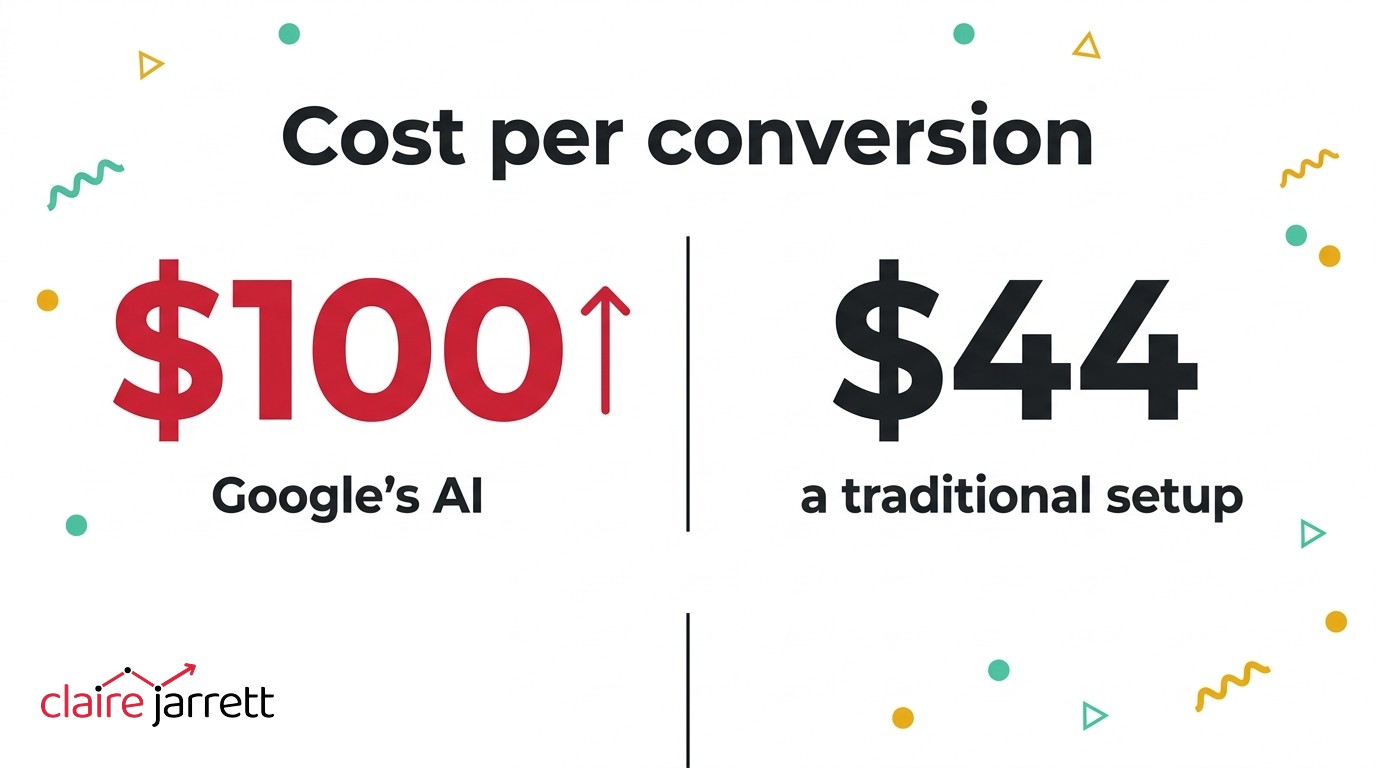
And it’s not as though Google’s own AI has earned the trust. Only last week it pushed back its deadline for forcing everyone onto its newer AI system, after independent tests put it at roughly $100 per conversion against $44 on a traditional setup.
That’s the company telling you to relax and let the machine drive, quietly admitting the machine isn’t ready. As one prospect put it to me, plainly: “Google is significantly untrustworthy.”
The skill that actually matters now
So if it’s not “learn every setting” and it’s not “hand it all to a machine,” what is it?
It’s judgement. It’s knowing what the automation is doing, what it’s allowed to touch, and where it is absolutely not allowed to go. The valuable skill in 2026 isn’t pressing the buttons — Google and AI will both happily press buttons all day. It’s reading the machine and keeping your hands on the wheel.
I’m not saying this as someone frightened of the technology. Quite the opposite. When I was on that call with the Irish business, here’s what I actually told them:
“I do use elements of AI. In fact, I’ve actually built AI systems that manage Google Ads. But it’s being aware of what it can do and what it cannot do.”
That’s the whole game. AI is a brilliant assistant and a terrible boss. Point it at a clean, well-built account and tell it exactly what you want, and it’ll save you hours. Hand it the account and walk away, and it’ll confidently take you somewhere you didn’t want to go — and you won’t find out until the money’s gone. The job now is putting very tight guardrails around the automation, Google’s and everyone else’s: telling it precisely what we want, and precisely where it’s not allowed to wander.
The man in New Zealand had the right instinct, by the way. He didn’t try to learn every new feature, and he didn’t throw it at a machine. He went looking for a human who actually understands the platform to take it off his hands. After ten years of watching it get more complicated, he knew the answer wasn’t more automation. It was someone accountable.
What I’d actually do
If Google Ads feels harder to you than it did a couple of years ago, you’re not imagining it, and it isn’t you. The platform genuinely has become harder to read, on purpose, and the automation that was sold to simplify it has mostly just hidden it.
Here’s where I’d start:
- Stop assuming “busier” means “better.” A lot of movement in your account isn’t progress — it’s Google rearranging things on your behalf. Check your change history for the last 90 days and see how much you didn’t authorise.
- Get the human work done first. Understand your customer, fix the website so it speaks to them, build the account properly. Automation on top of a solid foundation helps. Automation on top of a mess just scales the mess.
- Use AI to see, not to steer. It’s superb at explaining what your account is doing and what your reports actually mean. That’s the use that gives you control back. Letting it make unsupervised changes is the use that quietly takes control away.
- Get a real set of eyes on it. Not to learn every setting yourself, but to know what’s being done and whether it’s right.
That last one is what an audit is for. I look at the account, I tell you what’s actually happening behind the glass, and you decide what to do with it. No pressure, no jargon, just the truth about where your money’s going.
You know where I am.
A few questions I get asked
Has Google Ads genuinely got more complicated, or am I just behind? It’s genuinely got more complicated. People who set up accounts when it was simple — and ran them well for years — are telling me the same thing: the automation has made it harder to see what’s happening, not easier. You’re not behind. The glass got thicker.
If AI makes it harder, why do you use it? Because the problem isn’t AI — it’s handing AI the wheel. I’ve built AI tools that work inside my own business and I use them every day. The difference is what I point them at and in what order: AI to take away the labour and explain what’s going on, a human to make the judgement calls. Here’s where that line sits.
Should I just let Google’s automation run everything, then? Not unsupervised. Google even delayed forcing everyone onto its newer AI system after the numbers didn’t hold up. It needs a properly built account underneath it and tight guardrails around it before it’s safe near your budget.
I don’t have time to learn all this. What’s the realistic option? You don’t need to learn every setting — that’s exactly the trap. You need someone accountable who already knows the platform keeping watch over the automation. That’s the difference between control and just hoping.
Two ways I can help you get this right
Not sure whether it’s the automation, your setup, or something else draining your budget? Book a free Google Ads call and I’ll go through your account with you and tell you the truth about what I find.
Or register for my free masterclass — How to Overtake Your Top Google Ads Competitors in 8 Weeks — and I’ll walk you through the whole approach.

Claire Jarrett
Google Ads consultant since 2007, published author (6 books), and Google Partner. Claire was the first person to launch Google Ads training in Europe and has helped thousands of professional service businesses scale their leads.
More about Claire