The Death Spiral of Google Ads Managed by AI
Here’s where Google is heading, and they’re not hiding it. The plan is that one day you hand over your website, and Google works out what you sell, who’s likely to buy it, and how to reach them, on its own. No keywords, no campaigns, no human in the middle. Give the machine your URL and let it run.
It sounds like progress. It can’t work. And the reason it can’t work is the part nobody at Google wants to talk about.
The work that actually matters never gets done
In 19 years I have yet to open a client’s website that didn’t need serious work. Not because the owners aren’t clever. They usually know their business inside out. It’s that almost every website is written from the inside looking out. Every sentence starts with “we.” We offer. We provide. We’ve been established since 1998. Very rarely is a single line written from the point of view of the customer and the problem they’re trying to solve.
That’s the one piece of work that decides whether any of this succeeds: understanding the customer well enough to speak to them, not at them. It’s also the piece Google skips entirely. The machine doesn’t sit the owner down and ask who they’re really for. It assumes the website is already right and starts optimising on top of it.
It’s the first thing we do, before we touch an account: a proper deep-dive interview to work out who the customer actually is. Most small business owners have never stopped to think about it. They’ve got a service they want to get out there, and they’ve never once looked at their own website and asked whether it speaks to the person reading it. You have to teach people to think like their customer. Google doesn’t teach. It automates. And automation on top of a misunderstood customer is just a faster way to spend money badly.
What the machine is actually optimising towards
Say you do all the hard work yourself. You get the foundation right, the website sharp, the campaign properly built. Then you turn to Google for a bit of help, switch on a few recommendations, let it “optimise.” Before long it has done some genuinely random things. I wrote recently about an account where Google quietly rewrote the keywords to broad match and the results fell off a cliff. That isn’t rare. It’s the norm.
But the deeper problem isn’t the meddling. It’s what the machine is measuring. Google’s AI optimises towards conversions, and on most accounts I audit, the conversions it’s chasing aren’t real.
So I went back through the last 31 accounts I audited and counted.
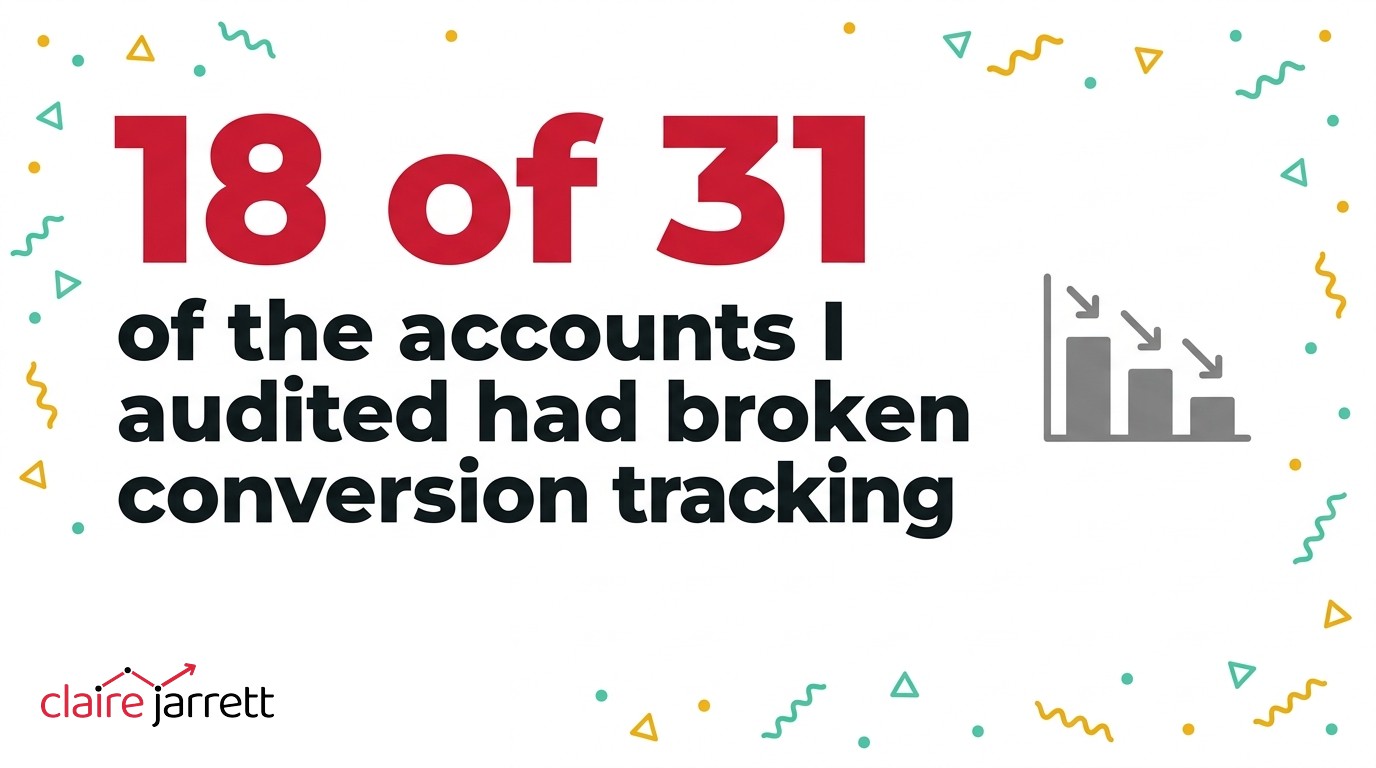
In more than half, around 18 of the 31, the conversion tracking was broken in some way. In 11, I flagged double- or triple-counting: one click recorded as two purchases, ten phone calls logged as twenty. One account had been quietly paying for every “sale” twice, and the owner had no idea. In nine, the thing being counted as a “lead” wasn’t a lead at all: a click for directions, a visit to the contact page, a look at the office location. Google had been told that someone checking the address was a conversion.
Then there’s the traffic itself. In nine of the 31, the Display Network or Search Partners had been left switched on inside a search campaign, quietly spending budget on apps, forums and videos that have nothing to do with the business. That’s where the genuinely junk conversions come from: spam contact-form enquiries, bot enquiries, phone calls meant for someone else entirely. Google’s own systems report these as conversions. They don’t catch that they’re fake.
This is the death spiral
Now put the two together, because this is the whole point.
You’ve got an account set to maximise conversions. The conversions are partly fake: double-counted, or junk from the display network, or a “directions” click dressed up as a lead. Google’s AI looks at that and decides it’s winning. So it does what it’s built to do: it goes and finds more of the same. More broad matching, more of the cheap traffic, more of the people who were never going to buy. The fake conversions multiply, the score looks healthier, and the account gets worse and worse and worse.
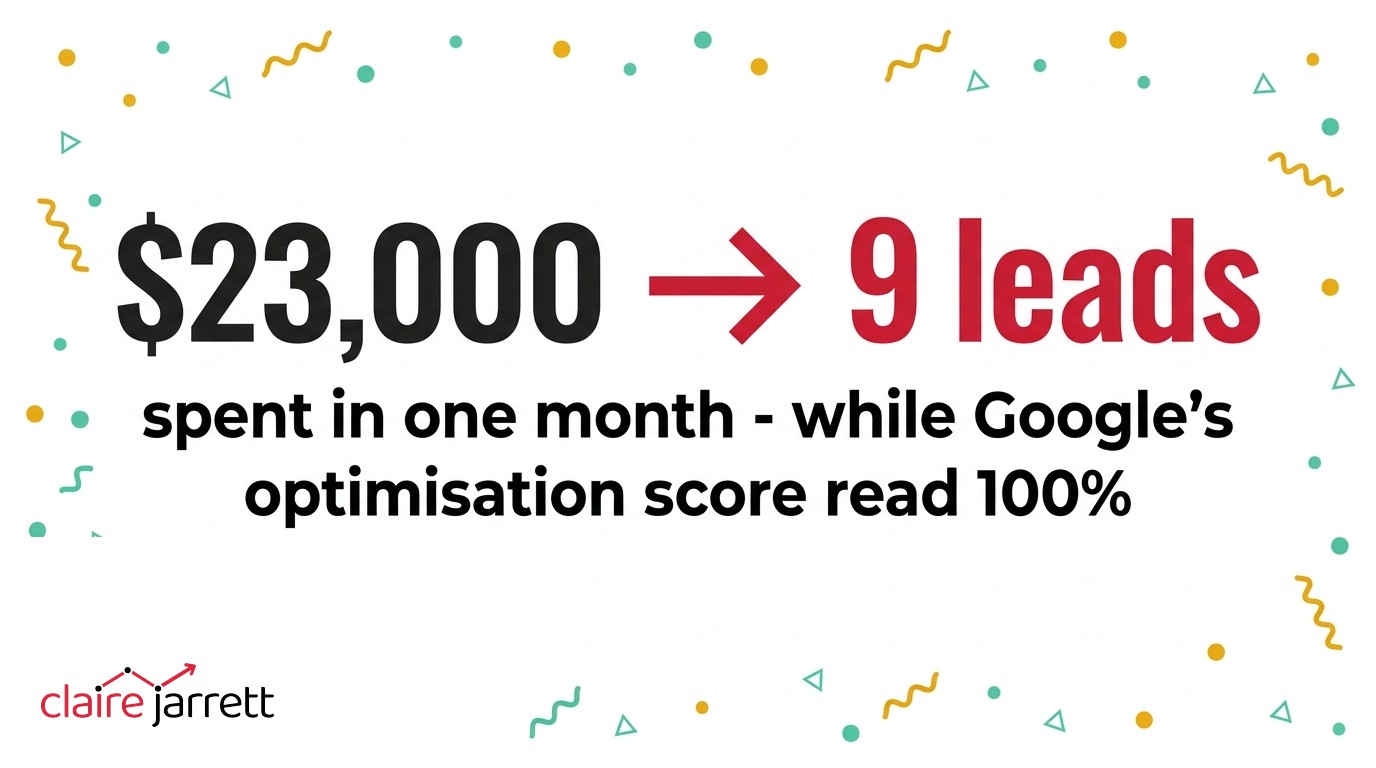
That’s the death spiral. One junk conversion teaches the machine what “good” looks like, and then it chases that definition off a cliff, confident the whole way down that it’s doing a brilliant job. I’ve seen an account spend $23,000 in a month and bring in nine real leads while Google’s optimisation score sat at 100%.
And the scale of the mess underneath is extraordinary. One air-duct company had 4,085 keywords crammed into a single ad group. A vaccine-injury law firm had 669, with one ad trying to answer “my arm hurts” and “I need compensation” in the same breath. One account was showing at the top of Google less than 10% of the time, haemorrhaging visibility to a low quality score, while the owner kept paying the bill every month.
Even Google just blinked
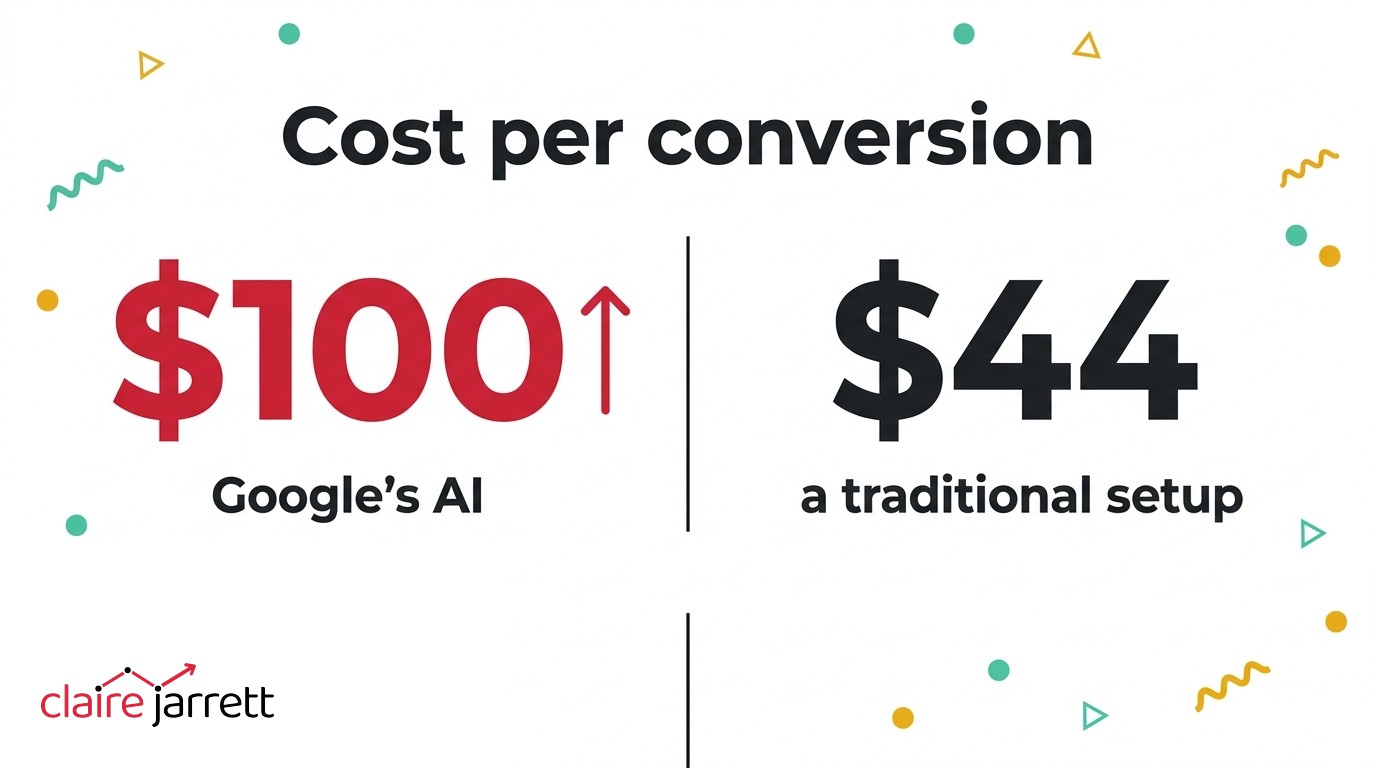
If the AI were ready, Google would be racing to force everyone onto it. Instead, last week it did the opposite. On 11 June it pushed back its own deadline for automatically migrating Dynamic Search Ad campaigns onto its newer AI system, from this September all the way to February 2027, after advertisers showed it sending the wrong traffic to the wrong pages, and independent tests put it at roughly $100 per conversion against $44 on a traditional setup. Google even quietly revised its own headline claim from “14% more conversions” down to 7%.
Read that again. The company telling you to trust its AI just gave everyone an extra eighteen months because the data wasn’t there.
But notice what didn’t change: it’s a delay, not a reprieve. The forced migration is still coming. The people who do nothing, who wait for Google, get moved onto the thing that’s already costing twice as much.
What I’d actually do
None of this means AI has no place. We build AI tools ourselves and use them every day. The difference is what we point them at, and in what order. And it’s worth being honest about what all this automation has done to the platform itself: it was sold to simplify Google Ads, and it’s done the opposite.
You do the human work first. Understand the customer. Fix the website so it speaks to them. Build the account properly: tight ad groups, real conversion tracking on something genuinely worth money, the display network and search partners off unless there’s a reason for them to be on. Then, and only then, you let the automation help, with very tight guardrails around it. This is what we want. Don’t go that way. Don’t go that way.
Google’s instinct is the reverse: skip the thinking, automate immediately, and let the machine sort it out. It can’t, because the machine never did the part that mattered.
If you’ve handed Google the keys and you’re not sure what it’s been doing with them, that’s what an audit is for. I look at the account, tell you what’s actually happening, and you decide what to do with it. You know where I am.
A few questions I get asked
What is the “death spiral” in Google Ads? It’s what happens when Google’s AI optimises towards conversions that aren’t real. It sees a junk conversion (a double-count, a “directions” click, a spam enquiry) and decides that’s what you want, then brings you more of the same. The numbers look healthier while the account quietly gets worse.
Should I turn off auto-apply recommendations? On almost every account I audit, yes. Auto-applied recommendations quietly change match types, bids and keywords in Google’s interest, not yours. I’d turn them off and have a proper look at your change history.
Is Google’s AI Max worth using? Not unsupervised, and not yet. Even Google has just delayed forcing everyone onto it. I’ve written a fuller guide to AI Max, but the short version is that it needs a properly built account underneath it before it’s safe anywhere near your budget.
How do I know if my conversion tracking is broken? If a keyword is showing more conversions than clicks, or your “leads” never actually call, something’s wrong. Broken tracking is one of the five mistakes I find in almost every audit.
Two ways I can help you get this right
Not sure whether it’s the AI, your tracking, or something else draining your budget? Book a free Google Ads call and I’ll go through your account with you and tell you the truth.
Or register for my free masterclass, How to Overtake Your Top Google Ads Competitors in 8 Weeks, and I’ll walk you through the whole approach.

Claire Jarrett
Google Ads consultant since 2007, published author (6 books), and Google Partner. Claire was the first person to launch Google Ads training in Europe and has helped thousands of professional service businesses scale their leads.
More about Claire