Your Dashboard Said 56 Leads. The Real Number Was 4.
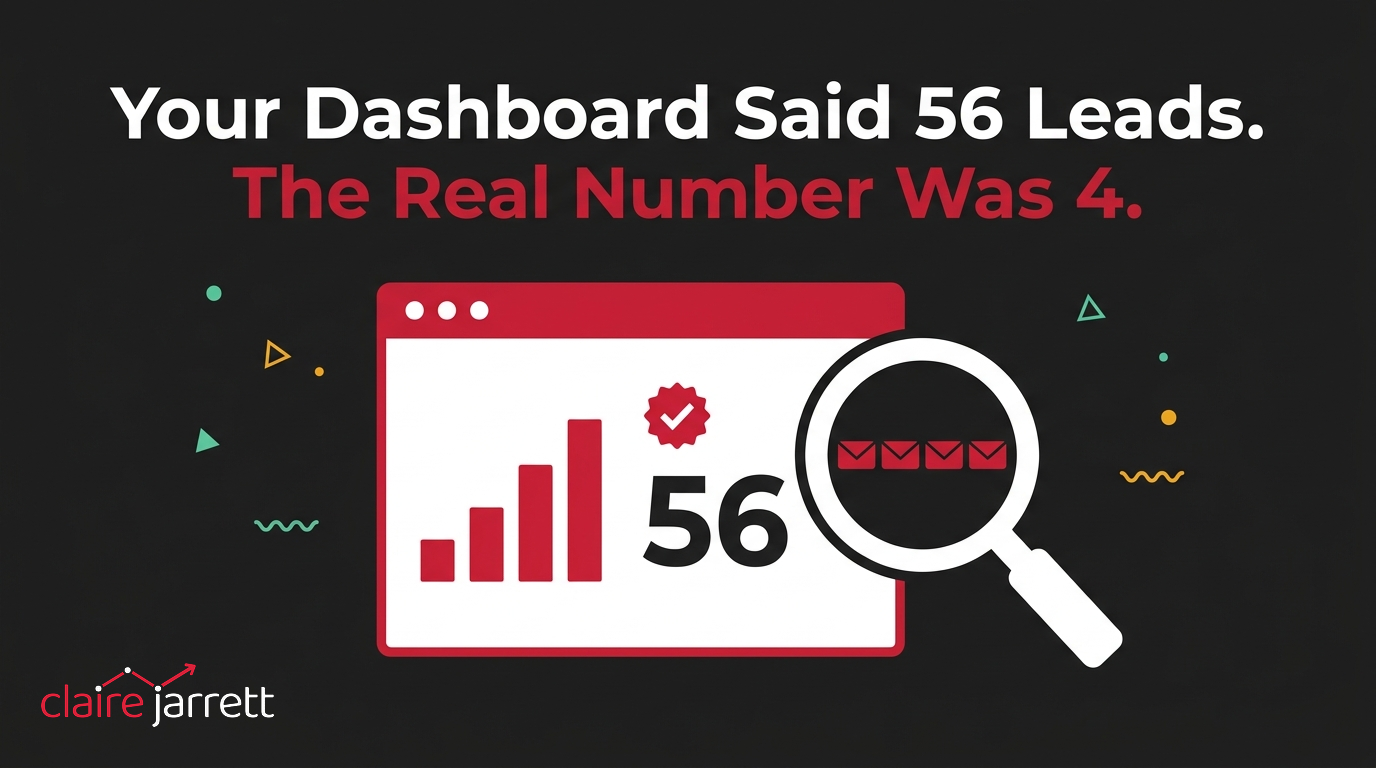
I audited an account recently for the owner of a specialist medical clinic. On paper it was doing nicely. The dashboard showed 56 conversions for the month at around $50 each, which in her industry would be a genuinely good result. Most owners would look at that number, feel reassured, and keep paying the bill.
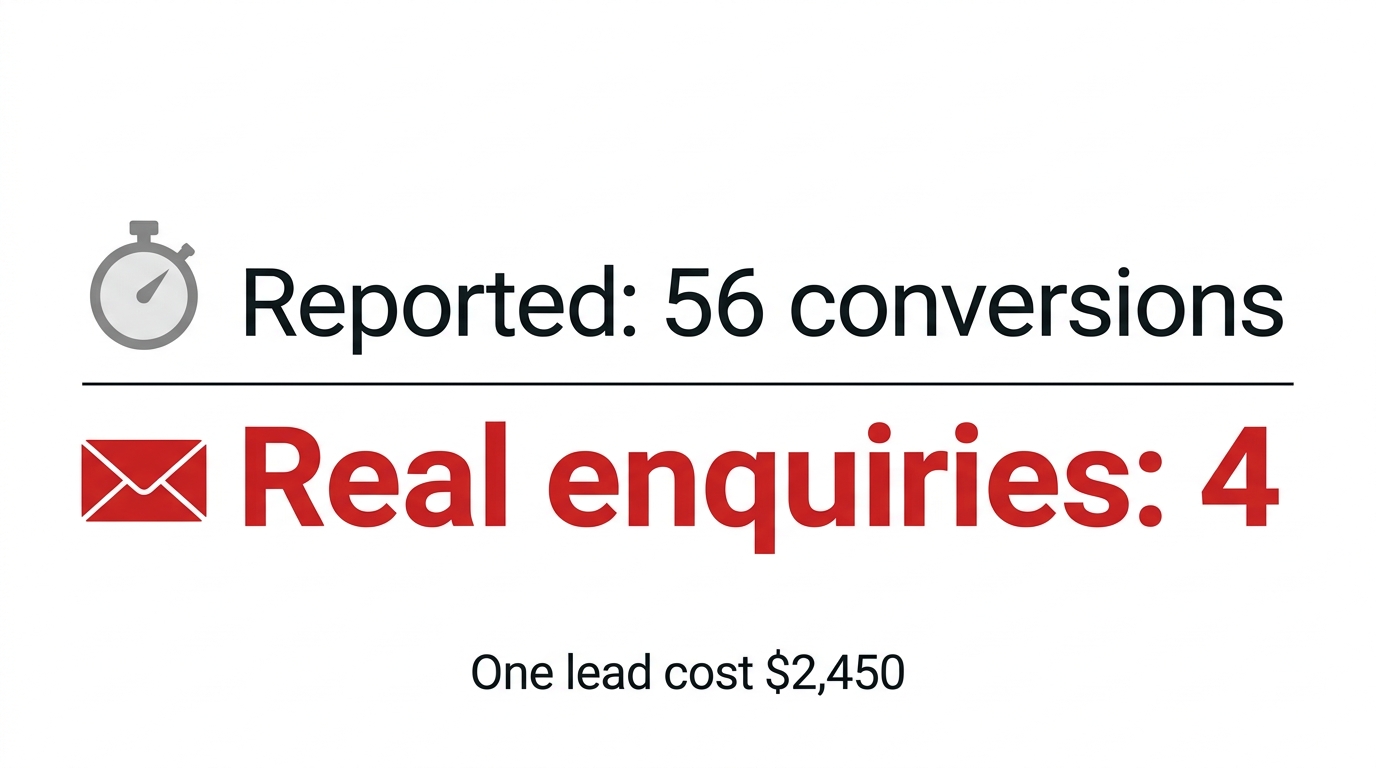
Then I counted the actual enquiries. The real number of people who had filled in a form and asked to book was 4.
Not 56. 4. And once you spread the real spend across those 4, one of them had cost $2,450. That is not a $50-a-lead account. That is an account with some serious problems, wearing a $50-a-lead costume.
So where did the other 52 “leads” come from?
When I opened the conversion settings, there it was. A “conversion” in this account wasn’t a person enquiring. It was a person staying on the page for 60 seconds and scrolling halfway down.
A timer. The account was counting patient enquiries and stopwatch readings in the same column, and the stopwatch was doing nearly all the work.
I understand how it happens, by the way. Google’s smart bidding needs conversions to learn from, and when the real ones are too rare, campaigns sit in learning mode going nowhere. Somewhere along the line, somebody solves that by giving the machine a target it can actually hit. Sixty seconds and a scroll. The algorithm cheers up immediately, the dashboard fills with green, and every report from that day on looks healthy.
The trouble is that nobody tells the machine the target is fake.
Smart bidding will hit any target you give it. Even a fake one.
Here’s the part that matters, because this is where it stops being a reporting problem and starts costing real money.
Google’s AI does not know what a patient is. It knows what you told it to find, and it is frighteningly good at finding more of exactly that. Tell it a conversion is a form fill and it hunts for people who fill in forms. Tell it a conversion is someone who reads for 60 seconds and it hunts for readers. Browsers. Researchers. The politely curious. People who are very good at scrolling and were never going to book anything.
That’s precisely what happened here, and I could see the moment it took hold. Before the timer took over, the account was producing 5, sometimes 8, real enquiries a month. Within a couple of months of the machine settling into its new job, that was 1 a month. Then 1. Then 1. The fake number climbed while the real one collapsed, and every report along the way said things were fine.
The smart bidding wasn’t broken. It was optimising, brilliantly, towards a scroll timer.
That’s the detail I’d want every business owner to sit with. The automation didn’t fail. It succeeded at the wrong thing. I’ve written before about the death spiral of Google Ads managed by AI, and this is the same story with one twist: this death spiral came with a green tick next to it.
Your conversion column is the steering wheel, not the scoreboard
Most owners treat the conversion number as a scoreboard. It isn’t. It’s the steering wheel. Every automated bid in the account is steered by whatever that column counts, so one junk conversion action doesn’t just flatter your reports. It actively points your budget at the wrong people, day after day, and gets better at it over time.
This is the same family of problem as the honey trap inside your Google Ads account: settings that quietly redirect your money while the surface looks fine. And it’s one more example of how the AI that was supposed to simplify Google Ads has done the opposite. The machinery is more powerful than ever. It just amplifies whatever it’s given, including a mistake.
How to check your own account this week
You don’t need me for this first bit. 10 minutes will do it.
- Read what each conversion actually is. In Google Ads, go to Goals, then Conversions, and look at what every action measures. Not what it’s called. What it measures. “Engaged visit”, “scroll”, “time on site” and “page view” are not enquiries.
- Check what’s marked Primary. Primary conversion actions are the ones smart bidding chases. An engagement timer set as Primary is steering your budget. If it belongs anywhere, it’s Secondary, as background data only.
- Compare the dashboard to your inbox. Count last month’s reported conversions, then count the enquiries your business actually received. If the account says 56 and reception heard from 6, the column is lying to you.
- Work out your cost per real enquiry. Take the month’s spend and divide it by the real ones only. That number is the truth of the account, and it’s the one nobody’s automation will ever show you.
By the way, AI is genuinely useful for this bit. Ask it to list your conversion actions and flag anything that isn’t a human asking to buy. That’s the right way round to use it: reading the account, not running it.
The bigger point
A number going up is not the same thing as a business going up. Machines optimise towards whatever target they’re given, and they’ll do it relentlessly. Choosing the right target is judgement, and judgement is still a human job. It’s the first thing my team and I check when we take over the management of an account, before budgets, before keywords, before anything: is the thing being measured actually a lead? Because you get what you pay for in Google Ads, and if what you’re paying for is scrollers, you’ll get scrollers.
If your dashboard says one thing and your inbox says another, that’s what an audit is for. I open the account, count the real conversions, and tell you exactly where the money’s going. You know where I am.
A few questions I get asked
What counts as a real conversion in Google Ads? A human asking to buy: a form fill, a phone call of reasonable length, a booking. If the visitor didn’t do something a salesperson would recognise as an enquiry, it isn’t a conversion. Everything else is engagement data, which is fine to record and wrong to optimise towards.
Are engagement conversions ever acceptable? As Secondary actions, yes. They can be useful background reading. The line is crossed the moment one is set as Primary, because Primary actions feed smart bidding, and smart bidding will chase whatever it’s fed.
Why would anyone set up a timer as a conversion? Usually to escape learning mode. When real conversions are too rare, campaigns stall, and a target the machine can hit makes everything look like progress. Sometimes it’s a shortcut that was never meant to be permanent and simply never got removed. The motive matters less than the effect: your budget ends up optimised towards the wrong people.
What if I don’t have enough real conversions for smart bidding? Then don’t force it. I start accounts on clicks, move to maximise conversions once there’s genuine data, and only then negotiate the cost per lead down with target CPA. Feeding the algorithm fake food to hurry that along is how you end up with an account like the one above.
2 ways I can help you get this right
Not sure whether your conversion column is telling you the truth? Book a free Google Ads call and I’ll go through it with you and tell you the truth about what I find.
Or register for my free masterclass, How to Overtake Your Top Google Ads Competitors in 8 Weeks, and I’ll walk you through the whole approach.

Claire Jarrett
Google Ads consultant since 2007, published author (6 books), and Google Partner. Claire was the first person to launch Google Ads training in Europe and has helped thousands of professional service businesses scale their leads.
More about Claire