
Google Ads News: October 2025

Last Updated on: 28th November 2025, 09:38 pm
October’s here, and with it, fresh Google Ads news. From reporting improvements to policy changes, I’ll walk you through everything you need to know to keep your account fresh and performing with the highest returns.
Let’s take a look!
1. Key Google Ads News about Reporting in October 2025
a. AI Max Search Term Reports Improvements: Sources Column
Google has introduced a new “Sources” column in the Search Term Reports for AI Max campaigns.
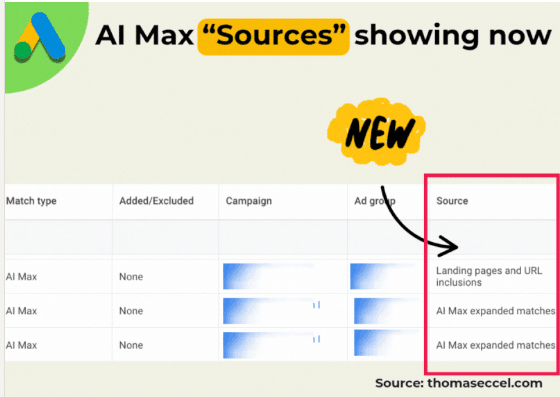
The new column breaks down where your traffic is coming from under AI Max automation, specifically showing when traffic is generated via two sources:
- Landing pages / URL inclusions: Which of your pages did Google use to match search intent?
- AI Max expanded matches: When did Google’s algorithm go beyond your explicitly set keywords and trigger matches with its own expansion logic?
As an advertiser, this means a peek into the AI Max black box, since you now see which pages are contributing to matching and triggering traffic. It becomes much easier to understand if Google’s AI Max is driving meaningful traffic.
Next Steps for These Google Ads News
If you’re already running AI Max campaigns, review the Sources column in your Search Term Reports. See which landing pages (or URL inclusions) are driving traffic. Are these pages aligned with your keyword/offer intent?
Then, analyse the expanded matches separately. Test ROAS and CPA for traffic displayed as “AI Max expansion” vs. more traditional matches. Are you seeing higher value, or are the expansions just diluting your performance?
If traffic is coming from pages that aren’t aligned, tighten up your URL inclusions, improve page relevance, or adjust your campaign setup.
Finally, because this is a rollout, use this data to observe patterns. Does the expanded match portion grow over time? Is performance stable? Is it improving?
If you find that the algorithmic expansions are underperforming, consider how you will allocate your budget or get in touch with me for an in-depth Google Ads account audit.
b. Performance Max Gets News Channel and Asset Reporting
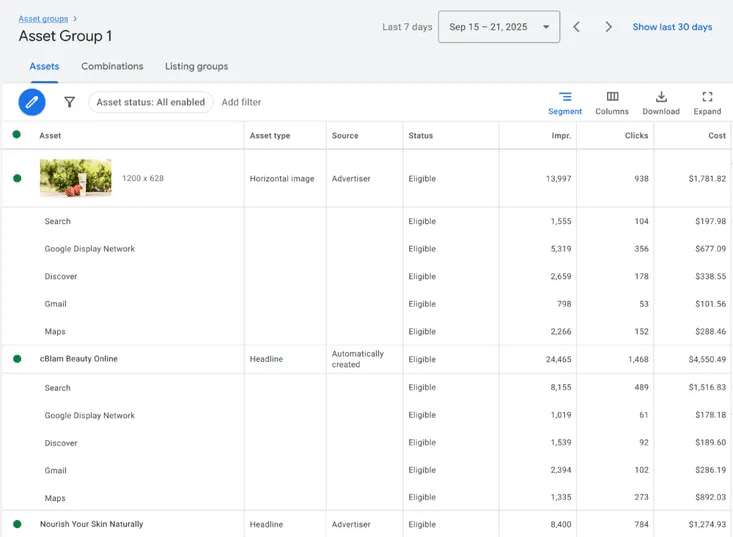
The second piece of Google Ads news that had me excited this month was opening up the Performance Max black box, too. You will now be able to see:
- Asset reporting: You can now segment asset-group and asset-level performance by device, time, conversions, and networks.
- Channel performance reporting: It now includes bulk reporting/downloads at account-level, cost metrics in channel visuals, ROI columns, segmentation by conversion action and ad-event type (e.g., engaged-view conversions), and diagnostics for issues.
- Network/channel breakdown for assets: You can see how individual assets (images, videos, text) are performing across Google’s inventory (Search, Display, YouTube, Discover, Gmail, Maps).
Head to Google Ads > Reports / Insights for your Performance Max campaigns and check for the “Channel performance” and asset-segmented reports.
Next Steps
Dive into your new data by all means, but don’t miss the forest for the trees! Have a plan when going in. This is what I recommend to my clients:
- Segment your asset report by device, time, network: see if any creative types/devices/networks are under-performing.
- Check channel distributions: Which channels (Search, YouTube, Display, Gmail, Maps) are driving the most conversions/cost? Use the cost toggle & ROI columns.
- Compare asset performance by channel: For example, does your image asset perform better on Display than on YouTube? If a channel is weak, change the creative or exclude that channel.
- Use diagnostics: Look for warnings like “limited serving due to bid targets” or “missing video assets” in the channel report. Fix those to maximise reach.
Finally, keep your automation, but start monitoring your Performance Max performance more closely. These Google Ads news finally let us see what’s happening under the “hood” of ad accounts and make wiser decisions!
c. Google Ads Channel Performance Report Now Includes Campaign Types
It keeps being good Google Ads news for advertisers in October! Now, we also have a new attribute column: “Campaign Type” inside the “Channel Performance” report.
Previously, you could only see information about Performance Max in the Channel Performance report. But now, it seems Google is expanding this report to include additional campaign types like Demand Gen campaigns, and perhaps even Search and Shopping.
The change hasn’t fully taken effect, but it’s a positive signal!
Keep an eye on your Channel Performance reports, and hopefully, we’ll soon be seeing the data for more than just Performance Max campaigns.
2. Google Ads News about Policy and Requirement Updates in October 2025
a. Google Ads Healthcare and Medicines Policy: It’s Good News!
While using Google Ads for healthcare or promoting medicine has always required extra caution, Google is now updating its policy for informational usage of prescription drug terms.
Specifically, starting from October 29, advertisers will be allowed to include prescription drug names in ad text and landing pages if the context is informational (e.g., public health campaigns, academic or legal notices) rather than direct product promotion.
When it comes to keyword targeting, the rules stay the same. If you target keywords for prescription drugs, you still need the right healthcare certifications.
I’ve written extensively on how I’ve navigated these rules in successful personalised healthcare advertising here, so I recommend taking a look.
b. Updates to Shopping Ads Misrepresentation Policy
Weren’t sure what really counts as misrepresentation in Shopping ads? Now you will be.
Google Ads has just clarified its Misrepresentation policy (for Shopping ads and free listings via Google Merchant Centre) with examples and guidance, especially around non-delivery, returns, and refunds.
c. Google Ads Message Assets News
If you’re using Message assets in your campaigns (for example, “Send us a message” as a CTA), you should review and update them by November 30.
This is because Google Ads is introducing new enforcement requirements for the “Message” asset type.
Right now, it’s not completely clear how (and if) the rules will change, but keep a close eye on your account starting from October 30, when you should see flags for any non-compliant assets.
d. Changes to the Default Conversion Goal Behaviour
Starting November 17, 2025, Google Ads will change how newly created account-default conversion goals are handled.
Essentially, it will stop setting conversion goals as account defaults.
Previously, when a new conversion action was created (especially via the API) Google would automatically generate a corresponding “customer conversion goal” and set it as account-default. Campaigns across the account could bid toward it automatically.
With this change, a newly created goal will only be set as account-default (i.e., auto-included in all campaigns) if and only if all existing goals in the same category are already account-default.
Ultimately, these Google Ads news are a win for clarity and strategy. When too many conversion goals are set as account-default, automated bidding strategies like target CPA may optimise toward less meaningful or less valuable actions. This change helps prevent “irrelevant” conversion signals from leaking into your bidding optimisation.
3. Shopping Ads: Now Featuring Subscriptions for Physical Products
If you’re in the US (and hopefully, soon expanding to other territories), you will now be able to promote subscriptions for physical products through your Google Shopping ads.
The eligible product categories right now include:
- Apparel & accessories
- Coffee
- Healthcare (not prescription medicine)
- Personal care
- Home & garden
- Pet supplies
- Prepared food
- Toys
You’ll have to submit them with required attributes, including:
- [subscription_cost]
- [period]
- [period_length]
… and there has to be a clear way to see the terms of auto-renewal, cancellation, and refund conditions.
However, this is a great step forward in allowing you to programmatically get higher recurring revenue and lifetime value. If you’re in the US and in the right categories, make sure you explore the new options or contact me to get started together!
4. View-Through Conversion Optimisation’ for Demand Gen
Google Ads is running a test of a new setting for Demand Gen campaigns that allows you to include view-through conversions (VTCs) in automated-bidding optimisations, and not just click-through conversions.
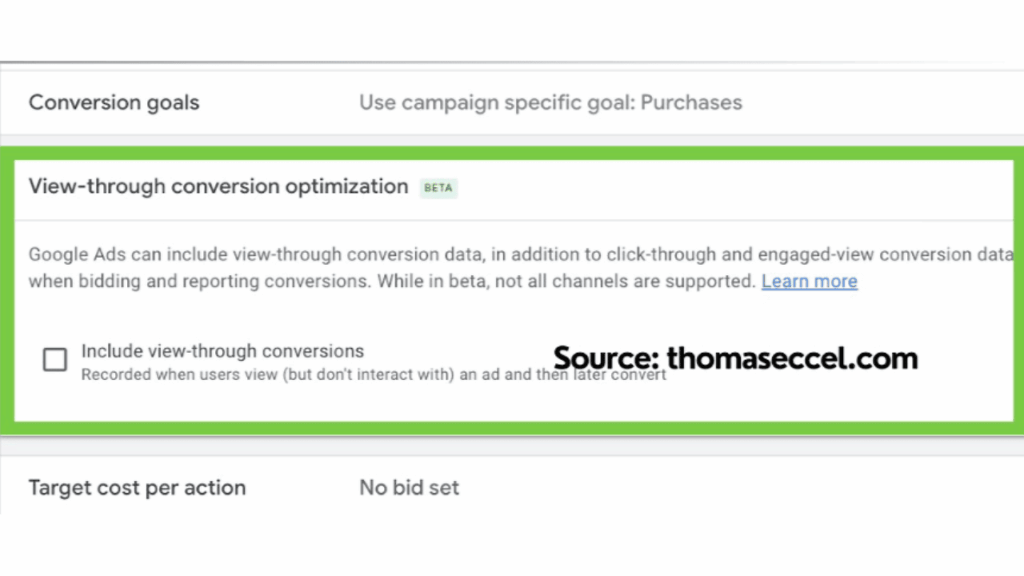
The logic is that if a user sees an ad (without clicking), then converts later, the campaign can count that as a conversion signal (“view-through”) and the system can optimise for it.
Otherwise, the view would have been “lost in the funnel” and potentially eliminated, even though it was one of the conversion touchpoints.
If you run Demand Gen campaigns already, check your Google Ads dashboard to see if the “View-Through Conversion Optimisation” setting is available in your account (since this is a test and may not yet be globally rolled out).
If it’s there, consider enabling it for campaigns with meaningful video/image creative and a longer conversion sales time (for example, high-ticket products).
5. Goodbye, Call-Only Ads!
Any Google Ads news article I’ve written in the past few months has had to include at least one sunsetting, and this October’s edition is no different.
This month, Google announced that the Call-Only Ads format will be retired.
New call-only campaigns will no longer be created after February 2026, and all existing call-only ads will stop serving by February 2027.
Fortunately, this gives you plenty of time to shift to Responsive Search Ads or Local Ads and set up your call assets for future campaigns.
If calls are the best way for you to track conversions, select Calls as your primary conversion goal, and you should see no difference from your good, old call-only campaigns.
Bonus Google News: Meta and TikTok Cost Imports in Google Analytics!
Google Analytics now supports integrations to automatically import cost data from Meta and TikTok’s ad platforms.
The import covers metrics like ads cost, ads clicks, and ads impressions, giving you a chance to see everything in your GA4 dashboard.
While this is not a replacement for supercharged omnichannel tracking tools you might be using, it is a good step forward.
Plus, importing is automatic once set up. You won’t need to manually reupload the data or use third-party connectors.
Changes, Changes, and More Changes in This Month’s Google Ads News
But this time around, they all feel like changes for the better.
Starting with transforming AI Max and Performance Max from black boxes into boxes you can actually see the ROI move in, and all the way to giving healthcare advertising more nuance.
Google Ads still has a long way to go, but this is the right direction. And as someone who has been running Google Ads for her own and her clients’ businesses since 2008, this month’s news has been a breath of fresh air.
If you want to discuss how these changes can impact your account, get in touch with me. I’d love to help!
