
Google Ads Compliance for Healthcare: The Ultimate Guide

Last Updated on: 1st February 2026, 05:44 pm
If you’re a healthcare practitioner thinking about Google Ads, you’re probably asking the same question I’ve heard from dozens of my medical clients:
“Is Google Ads even allowed for us?”
The answer is yes – as long as you respect the rules and structure your campaigns properly. And if you’ve already run some ads and hit compliance issues, then this guide will save you time, money, and headaches.
Compliance isn’t optional in medical advertising. But it’s not the enemy either. Once you understand the rules, you can outperform competitors who keep getting shut down.
So this is not a generic Google Ads guide. This is a Google Ads healthcare compliance guide written for practitioners who need patient leads and peace of mind.
1. Why Google Judges Medical Practitioners Differently
If you advertise healthcare, dentistry, weight loss, cosmetic procedures, or personalised medicine services or medication, your ads will be judged against higher standards.
That’s not paranoia. That’s the platform.
Google’s job is to protect users from misleading medical claims, exploitative messaging, and the misuse of sensitive data, so healthcare gets scrutinised more closely than most niches.
When you are in one of these sensitive interest categories, Google Ads will:
- Review your ad copy more closely
- Scrutinise your landing pages
- Restrict or prohibit remarketing
- Limit audience targeting
And if you’ve been using Google’s AI optimisations without closely checking if you are still compliant, they can push you into dangerous territory.
But – and this is important – not all compliance issues are equal.
2. The Three Types of Google Ads Healthcare Compliance Problems
There are three types of Google Ads healthcare compliance problems that new clients often come to me with, and they’re not all the same:
First are the ad disapprovals. They’re annoying, but common and fixable. They usually mean you crossed a wording line that Google’s systems don’t like. For example, you may have done one of these things:
- Used outcome-based language like “lose weight” / “fix”
- Used emotionally loaded phrasing
- You were too specific with the promised results
Implied a sensitive condition too directly - Referenced prescription pathways or drug names without the right certification
If you fix them quickly, there’s no lasting harm.
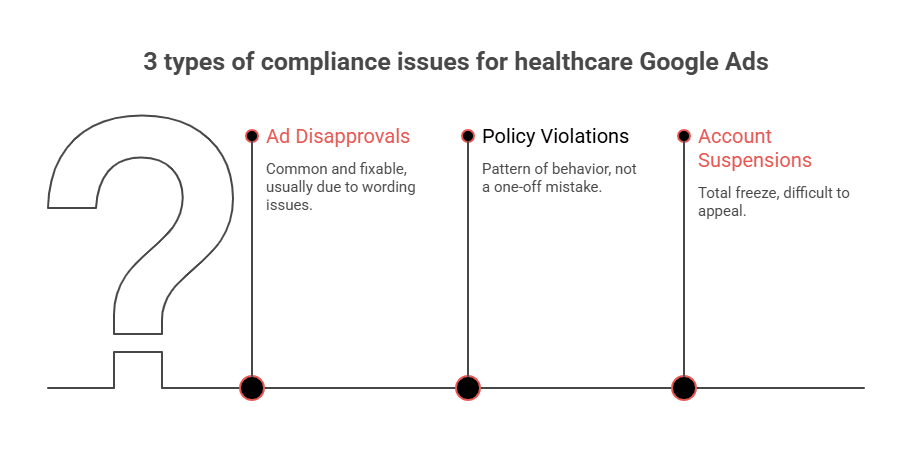
The second type is where advertisers get into trouble: policy violations. They occur when Google sees a pattern of behaviour, not just a one-off mistake. For example:
- Resubmitting disapproved ads repeatedly with only cosmetic tweaks
- Trying to “outsmart” the system with rewording tricks
- Ignoring Google’s feedback and pushing forward anyway
At this stage, Google stops assuming ignorance and starts assuming intent. Your account trust score drops, ads stop serving consistently, and you’re more likely to see restrictions.
P.S. This can happen even if you have an agency managing your ads for you. Unless they’re a consultancy that specialises in working with healthcare clients (with a focus on compliance), they might not know what they are doing wrong.
But Google doesn’t punish the agency. It punishes you.
Finally, the third type of Google Ads healthcare compliance issues is account suspensions.
It’s a total freeze – your ads stop serving. Yes, you can appeal the decision, but the process is slow, and many accounts that reach this point never regain access. From Google’s point of view, you’ve made too many mistakes intentionally – and they think you can jeopardise their users.
That is why I say compliance is foundational in healthcare.
3. Google’s Hidden Incentives (And Why They’re Riskier in Healthcare)
Google’s default settings are not built for your profit – they are built for Google’s profit.
In healthcare, that fine line is even thinner because an overly aggressive setup doesn’t just waste money – it can push you into compliance violations fast, and that’s where clinics get burned:
- Broad match keywords that explode into sensitive search terms
- Automated ad suggestions that introduce prohibited claims
- Auto-applied recommendations that widen targeting
- Turning on Display or Search Partners expansions because “Google recommended it”
But if a single click can “fix” your account, then a single click can break it. Your mindset in Google Ads compliance for healthcare needs to be: stay in control.
4. The Healthcare Compliance Foundation: What Google Actually Wants
In one sentence: your ads need to be relevant to what users are searching for. But in healthcare, the missing ingredient is often trust.
If your landing page feels vague, salesy, or medically questionable, patients hit the back button – and Google notices.
Google measures user behaviour. If users click your ad and bounce, your Quality Score suffers. Costs rise. Visibility drops. And if your content triggers sensitive policy flags, your ads may not run at all.
So compliance isn’t separate from performance. It is performance.
Compliance Area #1: Medical Claims (What You Can’t Say)
Healthcare advertisers get tempted to sell outcomes because outcomes convert. But in regulated niches, outcome language is often the fastest route to disapprovals.
For example, the following language would get you into trouble with Google Ads healthcare compliance:
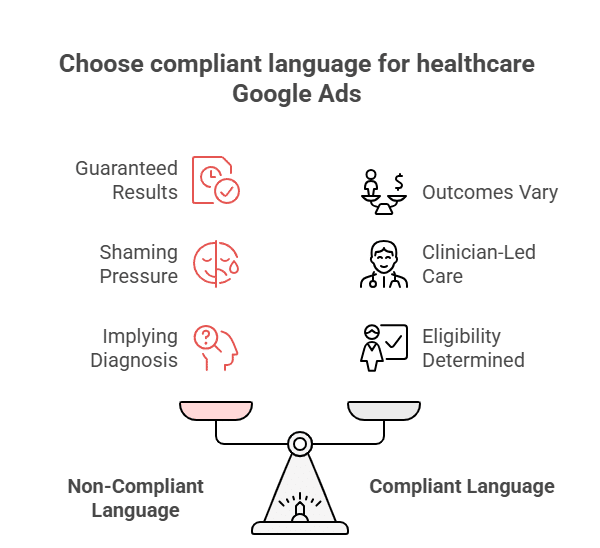
- Guaranteed results (“Cure”, “Fix”, “Permanent”, “Guaranteed”)
- Dramatic promises (“Lose 10kg in 30 days”)
- Implying diagnosis (“Do you suffer from…”)
- Shaming or emotional pressure (“Are you embarrassed by…”)
- Before/after style certainty (even if implied)
To stay compliant, write like a clinician. Focus on:
- Consultations
- Assessments
- Clinician-led care
- Evidence-based approach
- Eligibility determined by a professional
- Outcomes vary (and don’t lead with outcomes)
A useful mental check is: Could you say this in a clinical consult without cringing?
If not, rewrite.
Google Ads Healthcare Compliance Area #2: Remarketing for Sensitive Interest Categories
Many health services fall into “sensitive” categories (physical health conditions, mental health, reproductive health, addiction, weight loss, prescriptions).
Google’s position is simple: you are not allowed to target people based on inferred medical conditions or vulnerabilities.
Remarketing, by definition, does exactly that, and it’s where a lot of accounts quietly get flagged later.
For example, if someone visits a page about weight loss injections, fertility treatment, or a medical procedure, Google considers it invasive to follow them around the internet with ads reminding them why they were there.
Even if Google lets you set it up initially, accounts often get flagged once automated/manual reviews kick in.
Dentistry: The “Grey Area” for Healthcare Remarketing (proceed with caution)
Some dental services can use remarketing, while others absolutely cannot.
If you’re doing general dentistry, routine services, or cosmetic dentistry with careful wording, you may be able to run remarketing, but your ads must not imply a condition.
For example, remarketing to offer “Book a consultation” or “Visit a trusted local dental clinic” could be fine.
However, wording such as “Still looking for dental implants?” or “Fix missing teeth” would get you into trouble.
The rule of thumb I usually share with my clients is:
“If you wouldn’t feel comfortable explaining the ad to a Google policy reviewer, don’t run it.”
What to Do Instead of Remarketing in Healthcare
Once someone fills out a form, you can follow up with them via email, phone call, and educational sequences.
It’s still remarketing – it just doesn’t live in Google Ads, so you’re complying with the platform policy while still nurturing leads.
Compliance Area #4: Prescription Treatments and Pharmaceutical Certification for Healthcare Google Ads Compliance
This is the big one, especially with clinics offering prescription weight loss services and clinician-led injection programmes.
However, if you advertise prescription treatments (e.g. Mounjaro, Ozempic, Semaglutide), Google requires pharmaceutical certification.
And it applies even if you have licensed clinicians.
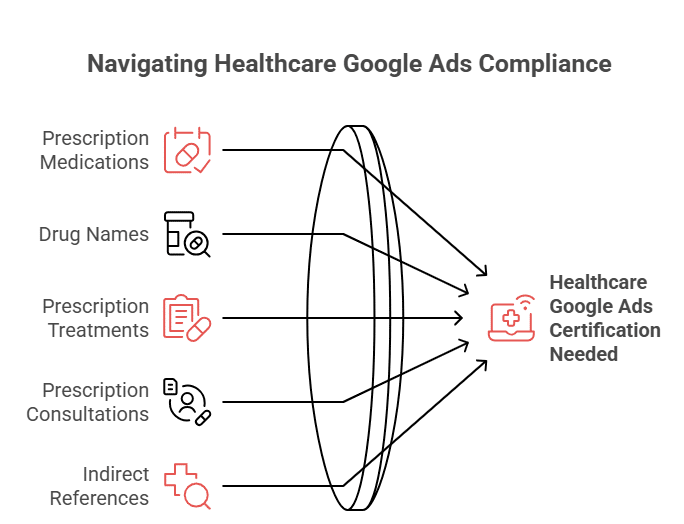
You must be certified to run healthcare Google Ads if:
- You advertise prescription-only medications
- Your ads reference drug names
- Your landing pages mention prescription treatments
- Your service includes consultations that may lead to prescriptions
- Even indirect references trigger enforcement (“medical weight loss injections”, “appetite suppression treatment”, “prescription support”)
The process does take time, but I’ve successfully done it for numerous clients. And in the end, you keep your account safe – instead of mistakenly trying to “test ads first” before demonstrating your certifications to Google, only to get stuck in account review loops.
Case Study: From Blocked Ads to Conversions in 8 Days (When Compliance Is Done Properly)
One of my clients offered prescription-based weight loss treatments, including Ozempic, as well as other regulated services.
Before working with me, they were repeatedly flagged for compliance, generated zero traffic, and found themselves in a situation where their ads were effectively blocked.
First, we fixed the certification issue. We stopped everything and handled Google’s certification process end-to-end: documentation, verification, business details, website alignment.
Then, we looked at their current campaigns and:
- Removed sensitive trigger language, implied outcomes, and exaggerated claims
- Replaced risky phrasing with compliant alternatives
- Studied what competitors were consistently getting approved
- Rewrote ads and reviewed landing pages
- Rebuilt keyword structure by intent
- Added negative keywords aggressively
- Moved to controlled phrase/exact-match targeting
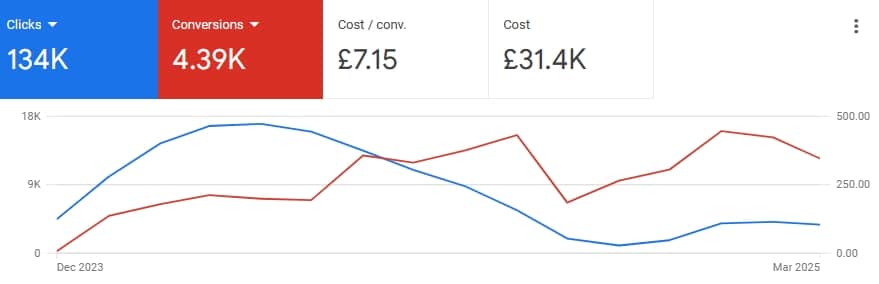
Only once data and traffic were “clean” did scaling begin. They started seeing conversions within the first 8 days of finishing the process successfully, and their account keeps performing even better with optimisations – regardless of the initial compliance hurdles.
Compliance Area #5: Keywords (and the Two-Keyword Trap)
Compliance isn’t only about ad copy. Your keyword strategy can drag you into sensitive territory fast.
Early-stage keywords (“teeth whitening”, “veneers”, “weight loss”) can bring education-intent traffic and ambiguous searches that trigger sensitive queries. In regulated niches like healthcare, that’s risky and expensive.
Later-stage searches are more specific:
- “Invisalign consultation Bristol”
- “Emergency dentist open now”
- “Veneers finance options”
Now intent is loud – and your ad can stay focused on consultation, location, and clinician-led care.
Why Google Loves the Two-Word Keyword Trap
Google’s defaults love short, broad two-word keywords. They maximise reach (and your spend).
However, in healthcare, broad two-word keywords can bleed budget, pull in sensitive queries, and trigger disapprovals or Google Ads healthcare compliance violations.
My suggestion?
- Identify the two-word culprits
- Push spend into longer (3+ word) phrases with intent/location modifiers
- Duplicate winning phrases as phrase + exact only
- Add obvious negatives (“cheap,” “free,” “how,” etc.)
- Review search terms daily in week one and then regularly as your campaigns keep working
- Treat broad/short terms as separate experiments later
This is both a profitability strategy and a compliance strategy – fewer junk queries means fewer policy triggers.
Google Ads Healthcare Compliance Area #6: Tracking and Data Cleanliness for Sensitive Niches
This part matters more than most clinics realise. In healthcare Google Ads, conversion tracking isn’t just a nice-to-have. It’s the difference between guesswork and growth.
Dirty tracking leads to dirty optimisation, which can push Google’s automation toward wider-query matching, lower-quality placements, and misleading “winning” messages that aren’t actually delivering results in the long term.
Healthcare Google Ads Case Study: Compliance Fixes Lead to 66% Lower Acquisition Costs
One of the clients who came to me was advertising their clinic, and they had a plethora of issues: their ads were getting flagged, their costs were rising, performance was inconsistent, and – worst of all – they had no reliable data.
First, we rebuilt their ads with compliance in mind. We removed sensitive phrases and implied outcomes.
Then, we got them off Display, which sends traffic that’s low-quality and simultaneously also policy trigger-happy. We fixed their tracking and strengthened landing page trust with bios, credentials, and reviews.
Ultimately, they saw 66% lower CPA.
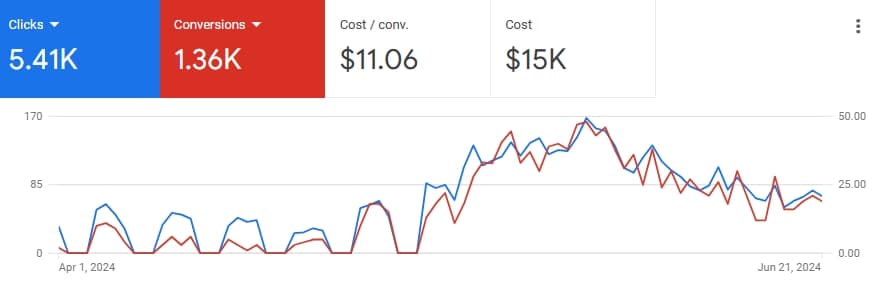
The moral of the story is: Google can’t optimise what it can’t see, but it will happily spend your money trying.
Compliance Area #7: Landing Pages Need Trust, Clarity, and “Clean” Messaging
A lot of healthcare advertisers obsess over ads and ignore the landing page – until approvals stall.
Google looks at your page the way a patient does:
- Is it medically credible?
- Does it match the search?
- Is it transparent about what’s offered?
- Does it feel safe?
So, to stay compliant while running healthcare Google Ads, use compliance-supportive landing page elements:
- List practitioner names and credentials
- State the clinic address and phone to demonstrate real-world legitimacy
- Give a clear explanation of the consultation process
- Add disclaimers where needed (“eligibility determined by clinician”, “results vary”)
- No “miracle” promises or guaranteed outcomes
- Use consistent language between keyword → ad → page
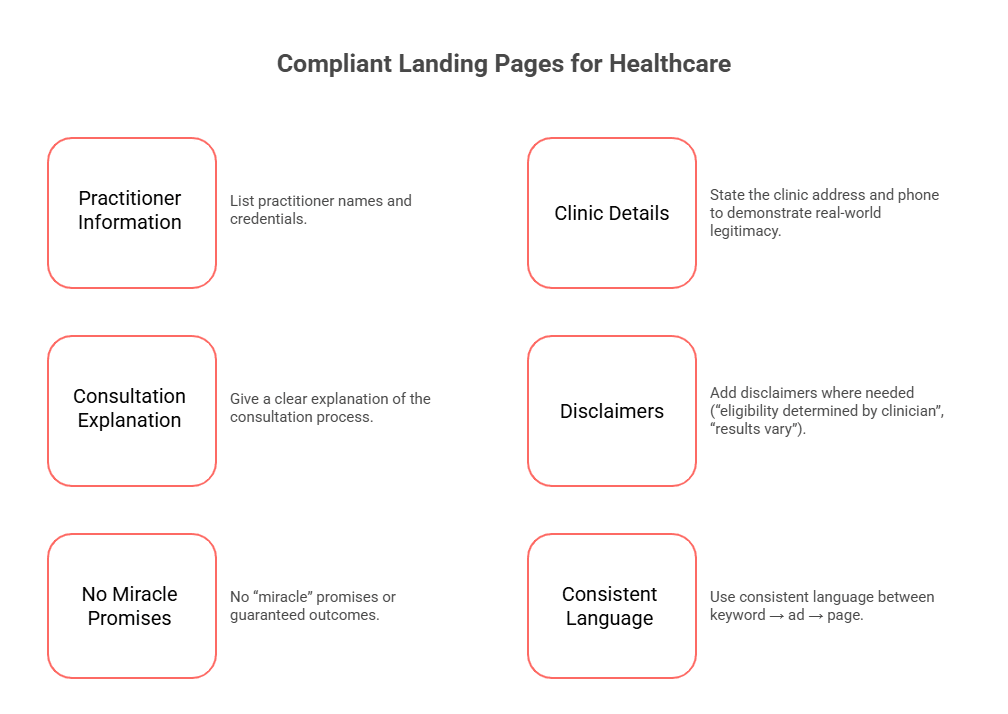
And don’t underestimate this: Relevance is compliance. If your ad implies one thing and the landing page sells another, you invite disapprovals and poor user behaviour.
A Final Warning about Agencies (Because This Is Where Clinics Get Burned)
If your agency:
- Can’t clearly explain why certain words are avoided
- Isn’t aware that remarketing is banned or restricted in many health categories
- Doesn’t know when certification is required (or how to help you navigate the process)
- Treats disapprovals as “normal” instead of warning signs followed by an immediate action plan
…they’re gambling with your account.
A disapproved ad is annoying. A suspended account can shut down a business overnight. If your agency doesn’t understand compliance, they are not qualified to manage your Google Ads – full stop.
Compliance Isn’t a Hurdle for Healthcare Google Ads – It’s the Strategy
Google Ads has changed the lives of many medical practitioners and clinics – from dentists and surgeons to weight loss clinicians and more – but the sensitive nature of your work means your Google Ads experience will be different from the start.
So if you take away just one thing from this guide, take this: Compliance isn’t a hurdle you clear once. It’s the foundation everything else is built on.
When certification, messaging, tracking, and structure are right, Google stops fighting you. Accounts stabilise. Performance becomes predictable. And you can scale without living in fear of the next policy email.
If you’re struggling with poorly-performing healthcare Google Ads right now or want to start advertising for the first time, knowing that you’re doing everything right, get in touch with me.
With 18+ years of experience and hundreds of healthcare clients, I’ll guide you through certification, compliance, and performance with one goal in mind: ensuring the right leads find your practice.
